

close
Choose Your Site
Global
Social Media


Views: 0 Author: Site Editor Publish Time: 2026-11-23 Origin: Site


Specifying the wrong chain type creates massive hidden costs that destroy facility profitability. Premature wear, catastrophic link failure, and unplanned downtime usually stem from a basic mismatch between chain metallurgy and the operating environment. Plant managers constantly face the headache of aligning chain pitch, tensile strength, and material composition with brutal on-site conditions. Corrosive washdowns, high-impact loading, sanitary regulations, and complex spatial layouts demand precise engineering. You cannot just guess and hope for the best. This guide provides a technical framework for evaluating and selecting the right conveyor chain types. We will show you how to match specific architectures to your exact load, environmental hazards, layout geometry, and throughput requirements. By understanding the mechanical limits of different designs, you can stop rapid elongation in its tracks and build a resilient material handling system that actually lasts.
Chain selection must prioritize environmental factors (temperature fluctuations, abrasive debris, chemical exposure) alongside maximum load capacity.
"Heavy duty" is not a universal specification; specialized designs like forged chains or offset sidebar chains serve distinct, application-specific failure-prevention roles.
Long-term performance for conveyor chains relies heavily on proper lubrication, tensioning, and alignment protocols, not just the initial purchase price.
Modern modular and customizable designs allow for complex production line layouts without sacrificing throughput.
Deploying the wrong chain architecture guarantees financial and operational penalties. Rapid elongation occurs when internal pin and bushing wear exceeds design tolerances. This forces the chain out of pitch with the sprocket. Fatigue failure follows shortly after. Maintenance overhead skyrockets as technicians constantly adjust tensioners, replace galled sprockets, and splice broken links. A misapplied chain does not simply break; it degrades the entire conveyor drivetrain.
Evaluating an industrial conveyor chain requires looking beyond basic dimensions. You have to understand how the metal behaves under stress. When a chain runs 24/7 in a dusty facility, the abrasive particles act like sandpaper inside the joints. If you specify a standard chain for this environment, you will replace it within months. You need to look at the surface hardness of the pins and the clearance between the plates.
Primary success criteria depend on specific baseline metrics. Ultimate tensile strength indicates the breaking point under static load. Maximum allowable working load dictates the safe operational limit for continuous use. Wear resistance determines how well the articulating joints survive friction and abrasive grit. The fatigue limit reveals the chain's ability to withstand cyclic loading without micro-fracturing. Finally, sprocket engagement efficiency measures how smoothly the chain enters and exits the sprocket teeth, directly impacting vibration and noise levels.
Performance Metric | Definition | Field Impact |
|---|---|---|
Ultimate Tensile Strength | The absolute maximum load before physical fracture. | Prevents catastrophic snapping during sudden jams. |
Maximum Working Load | The continuous load limit for safe, daily operation. | Dictates the motor size and throughput capacity. |
Wear Resistance | The surface hardness of pins and bushings. | Determines how long the chain stays in pitch before elongating. |
Fatigue Limit | Resistance to micro-cracking under repeated stress cycles. | Prevents sudden link plate failure after months of use. |
The load distribution mechanism of a bush roller chain relies on a precise assembly of pins, bushings, and cylindrical rollers. As the chain engages the sprocket teeth, the rollers rotate. This rotation minimizes sliding friction, converting it into rolling friction. The inner bushing protects the pin from direct impact, while the outer roller absorbs the engagement shock. You will see this design in almost every standard manufacturing plant.
Standard variants handle moderate loads efficiently. Heavy-duty variants upgrade the baseline performance significantly. They feature thicker link plates to resist fatigue and side-bowing. Through-hardened pins increase the shear strength and wear life under high tension. You evaluate these chains based on their ability to maintain pitch under continuous operation. They are the best fit for general manufacturing, packaging lines, and standard material handling applications requiring smooth, continuous power transmission.
When installing these chains, technicians must ensure the master link clip faces the correct direction. The closed end of the clip must point in the direction of chain travel. If installed backward, the clip can snag on a guide rail and pop off, causing the chain to separate under load.
A forged chain utilizes a remarkably simple yet robust construction. It consists of a forged center link, two forged side links, and a connecting pin. The drop-forged manufacturing process aligns the grain structure of the steel. This creates an exceptional strength-to-weight ratio. The rivetless design allows the chain to flex in multiple planes, which is a massive advantage for complex facility layouts.
Engineers evaluate forged chains based on their lateral flexibility. They handle vertical and horizontal curves without requiring complex joint assemblies or universal joints. The open design also prevents material packing in the links. This makes them the best fit for automotive assembly lines, overhead trolley conveyors, and heavy bulk material handling where the conveyor path navigates complex facility layouts.
Maintenance teams favor this design because assembly and disassembly require no special tools. You simply introduce slack into the system, rotate the pin, and slide the links apart. This drastically reduces downtime during emergency repairs.
The cranked link design defines the offset sidebar chain. Each link acts as both a roller link and a pin link simultaneously. The side plates bend inward at one end to accommodate the pin of the adjacent link. This uniform link construction eliminates the need for separate inner and outer links.
This architecture provides a superior ability to handle severe shock loads. The offset plates act as a natural spring, absorbing sudden impacts that would fracture straight-plate chains. Operationally, technicians can adjust the chain length by a single pitch, simplifying tensioning. They are the best fit for mining, aggregate processing, and heavy construction equipment where debris, abrasive dust, and violent impacts remain constant threats.
In a rock quarry, a standard roller chain would pack with dust and snap within a week. The offset sidebar design has generous clearances built into the joints. As the chain moves over the sprocket, the articulating motion forces the dirt and grit out of the joint, preventing it from binding.
Silent chains utilize interlocking toothed links rather than traditional rollers. These flat, gear-like plates engage smoothly and gradually with the sprocket teeth. As the chain wraps around the sprocket, the links pivot and seat themselves with minimal impact. This sliding engagement significantly reduces acoustic noise and mechanical vibration.
You must evaluate silent chains by weighing their high-speed capability and flat conveying surface against their higher upfront cost. They are highly sensitive to particulate debris, which can pack between the toothed links and cause jumping. They are the best fit for glass manufacturing, high-speed automotive parts conveying, and applications requiring minimal product marking and exceptionally low acoustic profiles.
Because the conveying surface is completely flat, these chains are excellent for moving fragile items. Glass bottles or machined engine components can sit directly on the chain without tipping or scratching. However, you must keep the operating environment exceptionally clean.
Engineered thermoplastics, such as acetal and polypropylene, form the foundation of modular conveyor chains. Manufacturers assemble these plastic modules in interlocking brick-lay patterns, secured by full-width hinge rods. This creates a continuous, highly adaptable conveying surface.
Evaluating these chains requires balancing trade-offs. They offer lower tensile strength compared to steel. However, they provide exceptional corrosion resistance, low friction, and strict sanitary compliance. The modular design allows for easy customization to suit complex production line layouts, including spirals, inclines, and tight radius curves. They are the best fit for food and beverage processing, pharmaceuticals, packaging lines requiring FDA/USDA compliance, and textile manufacturing.
If a section of a modular plastic chain gets damaged by a jammed pallet, you do not have to replace the entire belt. A maintenance worker can pop out the hinge rod, remove the broken plastic modules, snap in new ones, and have the line running again in ten minutes.
Engineering class chains encompass specialized designs like welded steel chains, cast chains, and leaf chains. Welded steel chains offer rugged durability for dragging heavy bulk materials. Cast chains resist severe abrasion in ash handling. Leaf chains consist entirely of interlaced plates and pins, designed primarily for high-tension hoisting, counterweights, and tension linkages.
You evaluate these chains based on their customization potential for extreme environments. Manufacturers can add specialized attachments, hardened wear surfaces, and custom metallurgy. They are the best fit for forestry, pulp and paper mills, and heavy-duty bulk material handling where standard roller chains would fail immediately.
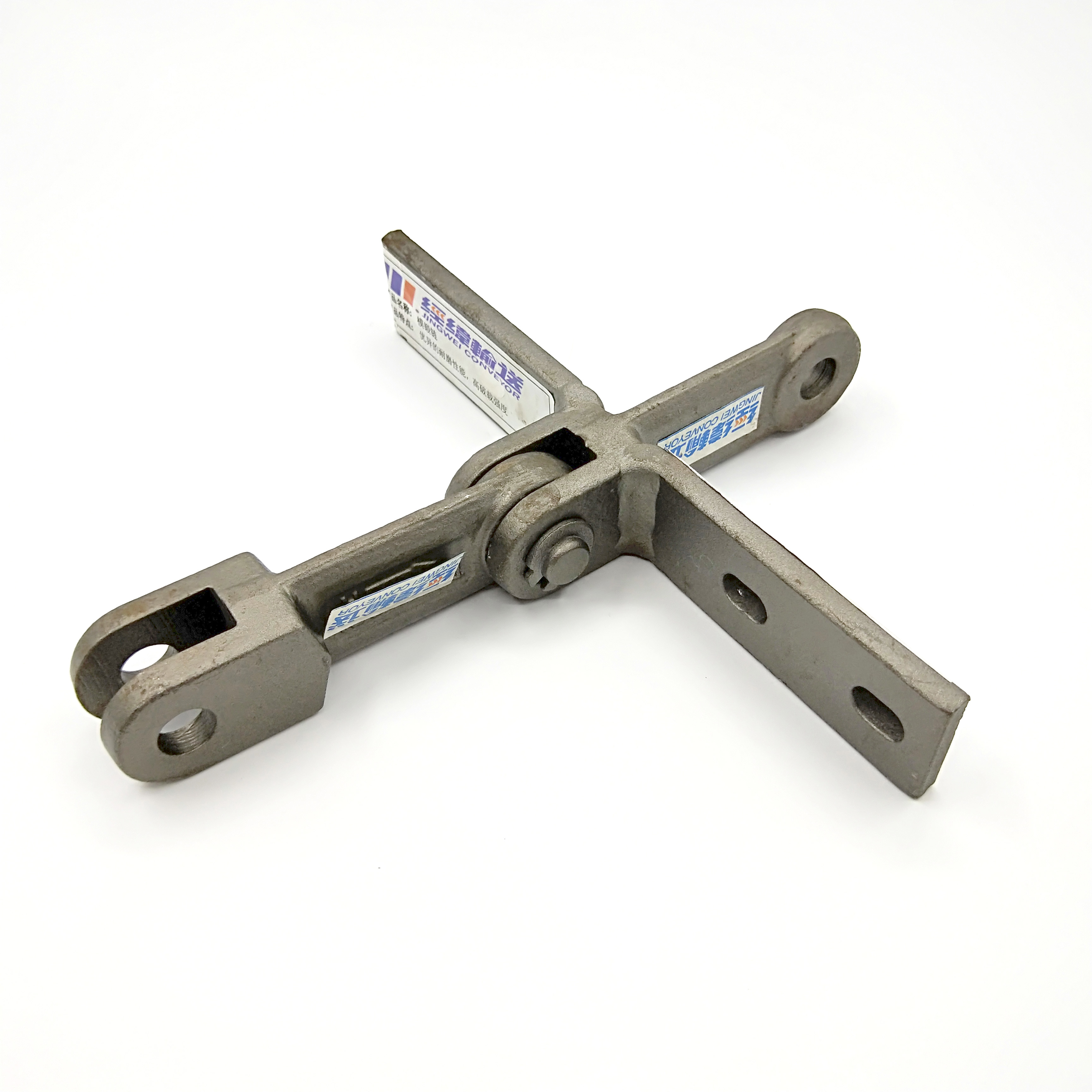
Mining operations demand extreme abrasive resistance and high shock load capacity. Conveyors move crushed rock, coal, and metallic ores. These materials generate highly abrasive dust that infiltrates chain joints. Sudden jams or surges in material flow create violent shock loads that test the ultimate tensile strength of the system.
Selecting a heavy duty conveyor chain requires specific engineering tolerances. Offset sidebar chains or welded steel chains dominate these environments. Their generous clearance tolerances allow abrasive debris to clear the joints naturally, preventing binding. The cranked link design of the offset chain absorbs the shock loads generated by heavy ore drops, preventing catastrophic link fracture.
When engineering a drive system for a mining conveyor, you must factor in the starting torque. A fully loaded coal conveyor requires massive force to break static friction. The chain must handle this initial spike in tension without stretching. We always recommend applying a service factor of at least 1.5 when calculating the required working load for these applications.
Sanitary processing environments enforce strict operational requirements. Conveyor components must survive high-pressure chemical washdowns. They require high chemical resistance to caustic cleaning agents. Furthermore, facilities often mandate zero-lubrication or food-safe lubrication environments to prevent product contamination.
Solution mapping compares stainless steel bush roller chains against modular plastic chains. Stainless steel offers higher load capacity but harbors bacteria in the pin-bushing joints if not cleaned rigorously. Modular plastic chains provide superior cleanability and layout adaptability. Solid-top plastic modules prevent liquid pooling, making them the preferred choice for direct food contact and pharmaceutical packaging lines.
In a meat processing plant, the washdown crew uses foaming chlorinated cleaners every night. Carbon steel chains would rust solid within 48 hours. You have to use 300-series stainless steel or acetal plastic. While 300-series stainless resists the chemicals, it has a lower working load than carbon steel, so you must upsize the chain pitch to compensate.
Automotive assembly lines require precision indexing, immense tensile strength, and continuous, multi-shift operation. The conveyor must move heavy vehicle chassis through welding, painting, and final assembly stations with exact positional accuracy. Downtime in these facilities costs thousands of dollars per minute.
Forged chains and specialized heavy-duty roller chains serve as the industry standard here. The rivetless forged design allows the chain to navigate the complex, multi-elevation routing of an automotive plant. The high strength-to-weight ratio handles the massive weight of vehicle frames, while precision-machined sprockets ensure exact indexing at robotic workstations.
During the paint shop phase, the chain passes through high-temperature curing ovens. Standard lubricants burn off, leaving the joints dry and prone to galling. We specify high-temperature synthetic lubricants or dry-film graphite coatings for these specific zones to ensure the chain articulates smoothly without contaminating the fresh paint.
Modern fulfillment centers require high-throughput sorting, extreme layout flexibility, and low-noise operation to ensure worker safety. Conveyor systems must handle varying package sizes, merge different product streams, and operate continuously at high speeds.
Modular plastic chains excel in complex sorting lines. Their low-friction surfaces allow packages to slide easily during diversion, and their modularity accommodates tight radius turns. For heavy pallet handling and automated storage and retrieval systems (ASRS), standard bush roller chains provide the necessary tensile strength and rigid power transmission required to move thousands of pounds reliably.
When designing a pallet handling system, you must account for the dynamic load when a forklift drops a 2,000-pound pallet onto the conveyor. The chain must absorb that impact. We use heavy-duty roller chains with thicker side plates to prevent the links from bowing outward under the sudden weight.
High ultimate tensile strength does not automatically equate to high wear resistance. Tensile strength measures the force required to pull the chain apart. Wear life measures how long the internal pins and bushings resist friction before the chain elongates out of pitch. A chain can possess massive tensile strength but wear out rapidly in a dusty environment.
You must decide when to prioritize surface hardness versus core toughness. If your application involves heavy, sudden impacts, prioritize core toughness (tensile strength) to prevent snapping. If your application involves continuous, moderate loads in a gritty environment, prioritize surface hardness (wear life). Specify case-hardened pins and bushings to combat internal friction while maintaining a ductile core to absorb minor shocks.
Think of it like a glass window versus a rubber tire. Glass is hard and resists scratching (wear resistance), but shatters under impact. Rubber is tough and absorbs impact (tensile strength), but wears down quickly. You have to find the exact metallurgical balance for your specific conveyor.
Standard conveyor chains require continuous lubrication to prevent rapid joint wear. This demands regular maintenance hours, automated drip systems, and constant monitoring. Conversely, self-lubricating or sealed (O-ring/X-ring) chains carry a higher upfront cost but drastically reduce maintenance overhead.
Assess the physical accessibility of your conveyor system. If the chain runs through elevated, enclosed, or hazardous areas, manual lubrication becomes dangerous and costly. In these scenarios, investing in sealed roller chains or sintered metal bushings (which release oil during operation) eliminates maintenance downtime. If the chain is easily accessible and operates in a clean environment, standard chains with manual lubrication protocols remain highly cost-effective.
When setting up an automated drip system, aim the nozzle directly at the gap between the inner and outer link plates. Dropping oil on the center of the roller does nothing. The oil must penetrate the pin-bushing joint to prevent internal wear.
Material selection dictates the survival of the chain. Carbon steel provides high strength and low cost, but it rusts rapidly in wet conditions. Stainless steel delivers excellent corrosion resistance but sacrifices tensile strength and costs significantly more. Engineered plastics ignore corrosion entirely but cannot handle heavy loads.
Match the metallurgy or polymer to the specific chemical, thermal, or sanitary constraints of the facility. Use the table below to guide your material specification:
Material Type | Tensile Strength | Corrosion Resistance | Ideal Industrial Application |
|---|---|---|---|
Carbon Steel | High | Low | Standard manufacturing, warehousing, dry environments. |
Stainless Steel (300 Series) | Low-Medium | Excellent | Food processing, chemical baths, high-temperature zones. |
Stainless Steel (400 Series) | Medium-High | Good | Washdown areas requiring higher load capacities. |
Engineered Plastics (Acetal) | Low | Outstanding | Direct food contact, bottling lines, sanitary packaging. |
Nickel-Plated Steel | High | Moderate | Humid environments where full stainless is too weak. |
Misalignment destroys conveyor chains rapidly. When sprockets fall out of alignment, the chain engages the teeth at an angle. This uneven load distribution causes side-plate galling, where the metal surfaces grind against each other. It accelerates sprocket tooth wear and frequently leads to premature chain jumping or snapping.
Implement laser alignment tools during installation to ensure perfect coplanarity between drive and driven sprockets. Conduct regular sprocket profile inspections; if the teeth resemble hooked shark fins, replace them immediately. Utilize automated tensioning devices to compensate for natural chain elongation. Proper tension prevents the chain from sagging and whipping, which degrades the fatigue limit.
You should check alignment across three axes. Angular misalignment happens when the shafts are not parallel. Parallel misalignment happens when the shafts are parallel but the sprockets are offset. Both will chew through the side plates of your chain in a matter of weeks.
Applying wet lubricant in a highly abrasive environment creates a fatal implementation risk. Abrasive particles (sand, coal dust, metal shavings) mix with the wet oil or grease. This mixture forms a highly effective grinding paste. Instead of protecting the joint, the contaminated lubricant accelerates rapid pin and bushing failure.
Specify sealed joints (O-ring chains) for dusty environments to keep factory grease inside and grit outside. If sealed chains are not viable, implement automated drip or spray systems that continuously flush the joints with clean oil. In extreme particulate environments, transition to dry-running materials, such as self-lubricating plastics or specialized dry-film graphite coatings, to eliminate the wet medium entirely.
If you notice red dust accumulating around the joints of a carbon steel chain, you have a severe lubrication problem. That red dust is fretting corrosion. It means the internal metal surfaces are grinding together dry, oxidizing, and pushing the rust out of the joint. You must intervene immediately.
No single chain type works for every facility. Successful specification requires a rigorous balancing of your maximum working load, environmental hazards, layout geometry, and operational speed. Relying on generic replacements guarantees recurring failures and constant maintenance headaches.
Follow a strict shortlisting logic. First, identify your environmental and spatial constraints, noting chemical exposure and curve requirements. Second, calculate maximum working loads and apply appropriate shock factors. Third, select the core chain type and material metallurgy. Finally, determine your specific attachment and sprocket needs to integrate the chain into your existing drivetrain.
Take immediate action to secure your material handling systems:
Audit your current chain failure modes by inspecting discarded links for galling, fatigue cracks, or elongated pin holes.
Calculate the actual dynamic shock loads on your system to verify your current chain pitch is adequately sized.
Request material samples of different chain alloys or plastics to conduct on-site environmental exposure testing.
Install laser alignment targets on your drive sprockets to verify installation accuracy during your next maintenance window.
A: Power transmission chains prioritize high-speed operation and utilize shorter pitch lengths to smoothly transfer rotational energy between shafts. Conveyor chains prioritize load-carrying capacity, feature longer pitch lengths, and often include specialized attachments or modified side plates to physically move materials along a designated path.
A: Use an offset sidebar chain in environments characterized by severe shock loads, heavy debris, and abrasive dust, such as mining or aggregate processing. The cranked link design absorbs impacts better than straight plates, and the generous clearances allow dirt to fall out of the joints.
A: Determine the correct size by calculating the maximum working load of your system. Multiply this base load by a service factor that accounts for shock loads, operating hours, and environmental harshness. Match this final calculated load against the manufacturer's maximum allowable working load for specific chain pitches.
A: Forged chains offer an exceptional strength-to-weight ratio due to the aligned grain structure of the drop-forged steel. Their rivetless, open design allows for high flexibility in both horizontal and vertical planes, enabling them to navigate complex overhead conveyor routings without binding.
A: Lubrication frequency depends entirely on operating speed, load, and environment. High-speed chains may require continuous automated drip or spray lubrication. Slower chains in clean environments might need weekly manual applications. Always establish a schedule that ensures a constant oil film exists between the pin and bushing.
A: Premature elongation is rarely caused by the steel stretching. It is caused by destructive wear of the internal pins and bushings. This internal wear creates clearance inside the joint, making the chain physically longer. Lack of lubrication, abrasive contamination, and overloading are the primary causes.


