

close
Choose Your Site
Global
Social Media


Views: 0 Author: Site Editor Publish Time: 2026-08-12 Origin: Site


Bucket elevators operate under continuous, punishing conditions where a single point of failure halts production. While engineers design these systems to move massive volumes of bulk materials, fastener degradation remains the most common, yet preventable, point of failure. Unplanned downtime, belt tear-out, and catastrophic equipment damage rarely stem from the bucket itself. Instead, these failures result from the gradual loss of clamping force and subsequent joint opening in the fastening system. Moving from reactive maintenance to engineered reliability requires understanding the exact mechanical forces driving elevator bolt loosening. You must evaluate purpose-built hardware designed to withstand dynamic industrial loads. We will break down the physics of fastener failure and provide actionable solutions to secure your conveying systems against continuous vibration and impact.
Preload Loss is the Primary Culprit: Fastener failure is rarely due to bolt fracture; it is driven by a loss of preload resulting in an opening in the joint. This occurs via two basic mechanisms: spontaneous rotational loosening or non-rotational slackening.
Vibration Drives Rotational Loosening: Transverse vibration and side-sliding of the bolt head relative to the joint cause relative motion in the threads, overcoming the friction needed to stay locked.
Belt Compression Causes Slackening: As rubber or synthetic belts compress over time (embedment), the joint loses tension even if the nut hasn't turned.
Engineered Solutions Outperform Standard Hardware: Upgrading to anti-loosening elevator bolts, fang bolts, and specialized locking mechanisms drastically reduces maintenance intervals and prevents catastrophic belt failures.
Understanding fastener failure requires looking at the physics of a bolted joint. A bolt functions essentially as a very stiff spring. When you tighten the nut, you stretch the steel bolt shaft. This stretching action creates internal tension. We refer to this tension as preload. Preload generates the clamping force required to pull the bucket tight against the belt carcass and hold it stationary. The entire integrity of the bucket elevator relies on this clamping force exceeding the external forces acting upon the bucket.
If the clamping force drops below the operational loads, the joint opens. Once a joint opens, the mechanics change drastically. The fastener no longer acts as a rigid clamp. Instead, it becomes a loose pin subjected to severe bending and shear stresses. A loose bucket elevator bolt will quickly fatigue, bend, or tear straight through the rubber belt carcass, leading to immediate equipment failure.
Mechanics often misunderstand the relationship between torque and preload. Torque is simply the rotational force applied to the nut. Preload is the actual stretch in the bolt. Friction consumes about 90% of the torque you apply. Only 10% of your effort actually stretches the bolt. If the threads are dirty, rusted, or damaged, friction increases. You might hit your target torque on the wrench, but the bolt remains under-stretched, leaving the bucket vulnerable to immediate loosening.
Maintaining preload requires the joint components to remain dimensionally stable. The belt, the bucket back, the washer, and the nut must all resist compression and wear. In a bucket elevator, dimensional stability is nearly impossible to achieve with standard hardware because the belt material is inherently compressible. This physical reality forces maintenance teams to rethink how they secure their buckets.
Rotational loosening happens when the fastener physically unthreads itself during operation. Shock, vibration, and dynamic loads cause the nut or bolt head to slide sideways relative to the joint surfaces. Engineers call this transverse vibration. This side-sliding creates micro-movements within the thread clearances.
This relative motion temporarily eliminates the friction holding the male and female threads together. Without friction, the internal off-torque generated by the stretched bolt causes the nut to rotate loose. This process happens incredibly fast. A few seconds of severe transverse vibration can completely eliminate preload in a standard fastener. Once the nut backs off even a fraction of a millimeter, the clamping force drops to zero.
The sequence of rotational loosening follows a predictable pattern in conveying systems:
A transverse force hits the bucket as it dredges through the boot section.
The bolt head slips laterally against the rubber belt cover.
The male and female threads slide against each other, breaking the static friction lock.
Thread friction drops to zero momentarily.
The internal tension of the bolt forces the nut to unwind down the thread pitch.
Standard hex nuts and flat washers offer zero resistance to this phenomenon. When the bucket hits the head pulley, the belt bends, but the rigid steel bucket does not. This mismatch creates a prying action that forces the bolt head to shift. If the hardware lacks a mechanical locking feature, the nut will inevitably back off.
Slackening occurs without any rotation of the nut. The primary cause in conveying systems is embedment. Belt materials, especially rubber and synthetic polymers, compress under heavy loads. When you tighten a bolt, the head and washer press deeply into the belt surface. Over time, the belt material undergoes localized plastic deformation. It yields and permanently thins out under the concentrated pressure.
Thermal cycling and continuous flexing accelerate this embedment process. As the belt shrinks in thickness, the stretched bolt naturally relaxes back toward its original length. Tension drops immediately. The joint opens. You lose clamping force even though the nut never turned on the threads. Slackening is inevitable in rubber belting, making proper hardware selection critical to maintaining joint stability.
Creep is another major factor in slackening. Rubber behaves like a highly viscous fluid under sustained pressure. The rubber directly under the bolt head slowly flows away from the high-pressure zone into the surrounding low-pressure areas. This material migration reduces the thickness of the belt at the exact point of fastening. You can often see this when removing old buckets; the belt has permanent, deep indentations where the hardware used to sit.
To combat slackening, you must distribute the clamping load over a larger surface area. Using oversized, hardened flat washers against the bucket back helps spread the load. However, you cannot easily increase the surface area of the bolt head without interfering with the belt's travel over the pulleys. This limitation makes slackening a constant threat that requires strict inspection intervals.
Bucket elevators run continuously under extreme dynamic conditions. Every time a bucket scoops material from the boot section, it experiences a massive load spike. As the bucket travels vertically up the casing, continuous vibration shakes the entire assembly. When it passes over the head pulley to discharge, the belt flexes, altering the geometry of the bolted joint.
This continuous loading and unloading cycle drives micro-movements in the joint. These micro-movements overcome thread friction and initiate rotational loosening. Standard fasteners cannot survive this environment indefinitely. The constant shift from tension to relaxation fatigues standard hardware, requiring you to implement countermeasures designed specifically for dynamic motion.
Consider the frequency of these load cycles. If a belt runs at 400 feet per minute, buckets strike the head pulley multiple times per second. This generates high-frequency vibration that travels straight down the bolt shaft. The threads act like a ramp. Under high-frequency vibration, the nut naturally wants to slide down that ramp. Without a physical barrier preventing rotation, the vibration will dismantle the joint.
The casing itself contributes to the problem. If the elevator casing is poorly supported or misaligned, the entire structure sways and vibrates. This structural resonance amplifies the forces acting on the buckets. You can often diagnose severe vibration issues by inspecting the bolt threads. If the threads look polished or heavily worn on one side, the bolt has been shifting laterally inside the hole.
Sudden resistance creates extreme shear forces across the bucket array. Oversized materials often wedge between the bucket lip and the elevator casing. Boot jams force the buckets to plow through compacted bulk solids rather than scooping loose material. These impact events transfer massive kinetic energy directly into the fasteners.
If the clamping force is already compromised by slackening, the shock load forces the bolt head to slide violently. This side-sliding triggers immediate rotational loosening. In severe cases, the shock load exceeds the yield strength of the bolt entirely, causing it to bend or snap off inside the casing. Protecting against shock loads requires both high-strength materials and secure locking mechanisms.
Different materials generate different shock profiles. Handling dry, free-flowing grain presents a relatively low shock risk. However, moving crushed glass, cement clinker, or heavy ores introduces massive impact forces. A single frozen chunk of coal entering the boot section can rip a standard bucket clean off the belt if the fasteners are already loose.
When a bucket tears out, it doesn't just fall to the bottom. It often gets caught between the belt and the pulley, acting like a wrecking ball. It rips adjacent buckets off, shreds the belt carcass, and destroys the pulley lagging. Preventing that initial fastener failure is the only way to avoid catastrophic casing damage.
Human error plays a massive role in fastener failure. Under-torquing fails to stretch the bolt enough during installation. You never generate sufficient initial friction to hold the threads together. The joint remains vulnerable to vibration from day one. Conversely, over-torquing is equally dangerous. Excessive torque stretches the bolt past its yield point, permanently deforming the metal and destroying its elasticity.
Over-torquing also crushes the belt carcass, accelerating embedment and slackening. Maintenance crews often use unregulated impact drivers for speed. This practice guarantees inconsistent preload across the bucket array. Some bolts end up dangerously loose, while others are stretched to the point of failure. You must use calibrated tools to ensure accurate and uniform tension across the entire belt.
The sequence of tightening matters just as much as the torque value. If a bucket has four mounting holes, mechanics should tighten the bolts in a cross pattern, similar to mounting a car tire. Tightening one side completely before moving to the other side pinches the belt unevenly. This creates a false torque reading. The wrench clicks, but the bucket isn't actually seated flat against the belt.
Thread lubrication also skews installation torque. If a mechanic applies anti-seize compound to the threads, the friction drops significantly. Applying the standard dry torque specification to a lubricated bolt will result in massive over-tensioning. You must adjust your torque targets based on the specific thread condition and any lubricants used during assembly.
Traditional designs rely on a large, flat head to spread the clamping load across a wide area of the belt. Most feature a square or ribbed neck located just under the head. The neck is intended to bite into the rubber and prevent rotation during the initial tightening process. For decades, this was the industry standard.
However, standard bolts have severe limitations in modern, high-capacity operations. Once belt embedment occurs, clamping force drops. The neck loses its tight grip on the carcass. In high-vibration environments, the bolt head begins to spin freely. Standard bolts offer zero resistance to rotational self-loosening once preload drops, making them a liability in heavy-duty applications.
The ribbed neck design specifically fails when used with modern, high-tensile synthetic belts. These belts have extremely tough top covers that resist penetration. The shallow ribs on a standard bolt cannot bite deeply enough to establish a mechanical lock. When the mechanic applies torque to the nut, the entire bolt spins in the hole, making it impossible to achieve proper preload.
Furthermore, standard bolts are often manufactured from low-grade carbon steel. They lack the yield strength required to survive heavy impact loads. When a boot jam occurs, the soft steel bends easily. Once the bolt bends, the joint geometry is permanently ruined, and the fastener must be cut off and replaced.
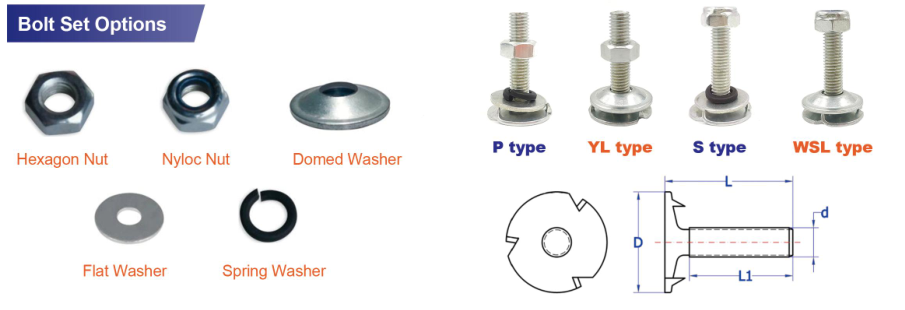
A fang bolt provides a massive mechanical advantage over standard flat-head designs. The head features integrated teeth or "fangs" protruding downward. These fangs bite deeply and aggressively into the belt carcass. When you tighten the nut, the fangs lock the bolt head rigidly in place.
This design prevents the head from spinning during installation. More importantly, it directly combats rotational self-loosening during operation. Even if slight slackening occurs due to belt compression, the fangs maintain a physical lock on the belt structure. The bolt simply cannot rotate. This mechanical lock preserves joint integrity far longer than standard ribbed necks.
The geometry of the fangs is engineered to penetrate the rubber cover without severing the internal fabric plies. The tension-bearing cords inside the belt remain intact, preserving the belt's overall strength. This targeted penetration creates a secure anchor point that resists the prying forces generated when the bucket travels over the head pulley.
Mechanics heavily favor these designs because they allow for true one-handed installation. The mechanic does not need to reach behind the belt with a wrench to hold the bolt head stationary. They simply push the bolt through the hole, seat the fangs into the rubber, and drive the nut home from the bucket side. This drastically reduces installation time during major belt overhauls.
Securing the nut is just as critical as securing the bolt head. An engineered anti-loosening elevator bolt system pairs specialized bolts with advanced locking mechanisms. Wedge-locking washers are highly effective in these environments. They use tension instead of friction to secure the joint. The cams on the washers interlock, meaning any attempt by the nut to rotate loose actually increases the clamping force.
Nylon insert lock nuts (Nyloc) provide friction-based resistance. They work well for standard applications but degrade rapidly in high-temperature environments. Deformed thread nuts offer all-metal locking power but can gall the bolt threads, limiting reusability. Selecting the right locking technology depends entirely on your operating temperature and vibration severity.
Wedge-locking washers operate on a simple geometric principle. The cam angle on the washer faces is steeper than the thread pitch angle on the bolt. If the nut tries to back off, it must ride up the cams. This action actually stretches the bolt further, increasing the preload. The vibration that normally destroys a joint actually locks a wedge-washer system tighter.
Deformed thread nuts, often called stover nuts, physically distort the top threads of the nut. When you thread them onto the bolt, the distorted section grips the male threads aggressively. This provides excellent resistance to vibration, but it damages the bolt threads upon removal. You should treat deformed thread nuts as single-use items to ensure maximum holding power.
Fastener Type | Resistance to Rotational Loosening | Resistance to Slackening | Best Application Environment |
|---|---|---|---|
Standard Flat-Head Bolt | Low | Low | Light-duty, low-vibration conveying |
Fang Bolt | High | Medium | Heavy-duty, high-impact environments |
Wedge-Locking Washer System | Very High | Medium | Extreme vibration, critical infrastructure |
Nylon Insert Lock Nut | Medium | Low | Ambient temperature, moderate vibration |
You must evaluate how aggressively a fastener grips the belt without causing damage. The goal is maximum hold without causing localized tearing. High vibration bucket elevator components must distribute operational loads evenly across the carcass. If the fangs or ribs are too sharp, they slice through the internal tension members inside the belt.
This internal damage compromises the belt's overall tensile strength, leading to premature snapping. Conversely, if the bolt head is too small, it punches straight through the rubber under heavy load. You must select fasteners matched specifically to the thickness, ply rating, and cover material of your conveyor belt to ensure a secure, non-destructive grip.
Steel cord belts require entirely different fastening strategies than fabric ply belts. You cannot drive fangs into a steel cord belt without risking severe damage to the cables. For these heavy-duty applications, you must use specialized clamping plates that grip the belt via friction rather than penetration. Always consult your belt manufacturer before changing fastener styles.
The punch pattern on the belt also dictates fastener selection. Standard buckets use a specific hole spacing, typically on 4-inch or 6-inch centers. If you upgrade to a larger diameter bolt to increase yield strength, you must ensure the new hardware fits the existing punch pattern without removing too much rubber between the holes. Removing too much material creates a weak tear line across the belt width.
Material grade determines survival in the casing. Grade 2 bolts work adequately for lightweight agricultural products like dry grain. However, they fail rapidly in industrial applications. Heavy ores, aggregates, and cement require Grade 5 or Grade 8 fasteners. These higher grades offer superior yield strength, resisting stretching and bending under severe impact.
Stainless steel options provide critical corrosion resistance in wet, acidic, or chemical environments. However, stainless steel possesses different torque-tension characteristics than carbon steel. You must adjust installation procedures and apply anti-seize compounds to prevent thread galling. Always match the fastener's metallurgical properties directly to the weight and impact demands of the conveyed material.
Yield strength is the exact point where the steel permanently deforms. If a shock load stretches a Grade 2 bolt past its yield point, it will not spring back. The preload is gone forever. Grade 8 bolts have a much higher yield point, allowing them to absorb massive shock loads, stretch momentarily, and return to their original length, preserving the clamping force.
When selecting stainless steel, you must understand the difference between 304 and 316 grades. 304 stainless handles general moisture well, but 316 stainless is mandatory if you convey materials containing chlorides or harsh fertilizers. Using the wrong grade of stainless will result in rapid stress corrosion cracking, causing the bolt heads to pop off unexpectedly.
Upgrading your hardware directly impacts your maintenance schedule. Standard fasteners require constant monitoring. Mechanics must frequently open the casing doors, jog the belt, and manually check hundreds of nuts for tightness. This process consumes massive amounts of labor hours and forces the production line to shut down.
Engineered fasteners eliminate this repetitive labor. By physically locking the joint against vibration, you extend the intervals between required inspections. Mechanics can focus on preventative maintenance elsewhere in the plant rather than constantly fighting loose buckets. The reduction in labor hours quickly justifies the investment in better hardware.
Furthermore, preventing a single bucket tear-out saves tens of thousands of dollars in secondary damage. A torn belt requires a massive splicing operation. The facility loses days of production while contractors vulcanize a new belt section. Securing the buckets properly is the cheapest insurance policy you can buy against catastrophic casing failure.
You must track your maintenance logs to see the real impact. Document every time a mechanic replaces a missing bucket or retorques a loose array. Once you install engineered fasteners, track the same metrics. The drop in required interventions will clearly demonstrate the value of upgrading your fastening strategy.
Ditch the unregulated impact drivers immediately. You cannot guess preload by feel or sound. Use calibrated torque wrenches for all installations. Establish clear torque specifications based on the bolt grade, thread size, and belt material. Document these specifications clearly in your facility's maintenance manuals.
Train your technicians on proper tightening sequences. A consistent, verifiable torque application prevents premature joint opening. It ensures every bucket carries its exact share of the load. Implementing a strict torque protocol is the single most effective administrative control you can use to prevent fastener failure.
Calibration is not a one-time event. Torque wrenches drift out of spec over time, especially if they are dropped or stored improperly. You must implement a tool calibration schedule. Send your torque wrenches to a certified lab annually. A wrench that reads 15% low will leave your entire bucket array dangerously under-tensioned.
Create a visual management system for your fasteners. After a mechanic torques a nut to the correct specification, they should apply a stripe of torque-seal paint across the nut, washer, and bucket back. This paint stripe provides an immediate visual indicator during future inspections. If the stripe is broken, the nut has moved, and the joint requires immediate attention.
Upgrading hardware requires careful compatibility checks. Ensure new anti-loosening hardware matches your existing belt hole diameters perfectly. A loose fit in the belt hole allows lateral movement, accelerating wear and tearing the rubber. Verify the bucket punch patterns align perfectly with the new fasteners before ordering bulk supplies.
Upgraded locking washers often have larger outside diameters than standard flat washers. Ensure they sit completely flat against the bucket surface without riding up on the bucket radius or interfering with the bucket wall. Proper fitment is non-negotiable for joint stability. A mismatched washer will create uneven loading and induce bending stress on the bolt.
Follow these steps when retrofitting your system:
Measure the exact thickness of your current belt and bucket back to determine the correct bolt length.
Verify the hole diameter in the belt matches the shank diameter of the new fasteners.
Test fit a single bucket array to ensure the new washers sit flat against the mounting surface.
Check the clearance between the new bolt tails and the elevator casing to prevent scraping.
Do not mix old and new hardware. If you upgrade to a wedge-locking washer, you must use a new nut and a new bolt. Reusing old, fatigued bolts with new locking mechanisms defeats the purpose of the upgrade. The old bolt has likely already yielded and will fail regardless of how well the new washer holds the nut.
Belt compression is an unavoidable reality. You must account for initial embedment when installing new hardware. Establish a strict retorquing schedule post-installation. Inspect and retorque all elevator bucket fasteners after the first 48 hours of continuous operation.
Perform a second comprehensive check after one week of running under load. Once the joint stabilizes and the belt stops compressing, you can integrate inspections into your standard preventative maintenance schedule. Base these ongoing intervals strictly on operational hours and load severity, rather than arbitrary calendar dates.
The 48-hour check is critical because rubber creeps rapidly under initial pressure. During this first inspection, mechanics will often find that nuts which were perfectly torqued two days ago are now completely loose. This is not a failure of the locking mechanism; it is the physical reality of the belt shrinking. You must re-establish the preload.
Always follow strict lockout/tagout (LOTO) procedures during these inspections. Lock out the main drive motor. Open the inspection doors. Manually jog the belt to bring each bucket array into view. Visually inspect the torque-seal paint stripes and physically test a sample of nuts with a calibrated wrench to verify the clamping force remains intact.
Map out your current hardware and identify signs of embedment, belt tearing, or rotational loosening across your bucket arrays.
Switch to calibrated torque wrenches for all installations to ensure consistent and accurate preload across the entire belt.
Upgrade to fang bolts in high-impact or heavy-duty conveying applications to prevent the bolt heads from spinning under load.
Establish a strict 48-hour retorque rule after installing new hardware to combat initial belt compression and slackening.
Consult with a fastener specialist to specify the exact material grade and locking mechanism for your specific load profile.
A: Initial torque creates preload, but sustained preload is hard to maintain. Embedment causes the belt material to compress over time. This compression leads to slackening, causing tension loss without nut rotation. Additionally, severe transverse vibration can overcome thread friction, leading to rotational self-loosening.
A: It is a specialized fastening system designed to resist dynamic forces. These systems utilize integrated teeth, deformed threads, or tension-based wedge-locking washers. They actively resist rotational self-loosening and relative thread motion, keeping the joint secure in high-vibration applications.
A: The integrated fangs penetrate the belt carcass during installation. This physical bite locks the bolt head in place. It prevents the head from spinning under load. By stopping rotation, fang bolts maintain joint integrity and prevent the fastener from backing out during operation.
A: Standard split-ring lock washers are generally ineffective in these applications. They flatten out under load and offer almost zero resistance to severe transverse vibration. Wedge-locking washers or specialized lock nuts provide significantly better protection against side-sliding and tension loss.
A: Inspect and retorque newly installed components after the first 48 hours of operation to account for initial belt compression. Perform a follow-up check after one week. Afterward, integrate inspections into your standard preventative maintenance schedule based on operational hours and load severity.


